Ecuador Entry Requirements
Entering Ecuador is simple for most visitors. The paperwork starts with the Galapagos: a USD 20 transit control card bought in Quito or Guayaquil, and a USD 200 park fee paid on arrival. Visas, vaccines, insurance and phone options are below, each checked against official pages.

What Visitors Need To Know In October 2026
- Fees: The Galapagos park fee is still USD 200 for foreign adults and children from 12, in force since 1 August 2024; no increase has been announced.
- Update: The Transit Control Card costs USD 20 and can be registered online on the CGREG platform before you travel.
What Do You Need To Enter Ecuador?
A passport valid for at least six months and a return or onward ticket that you may be asked to show. Citizens of the US, UK, Canada and EU countries need no visa for up to 90 days in any 12-month period. No COVID or vaccination documents are required. The Galapagos add their own paperwork.
Since October 20, 2022, Ecuador has had no COVID-19 entry requirements, and no test or vaccination card is needed to enter. The national mask mandate was lifted on 28 April 2022. Ecuador also stopped requiring a yellow fever certificate from travelers arriving from Colombia, Peru, Bolivia and Brazil in August 2025, though vaccination is still a recommendation, and a certificate can be required under international health rules for arrivals from certain countries.
Ecuador's foreign ministry lists the nationalities that do need a visa, and no EU member state appears on it. If you continue to the Galapagos, you need a personal, non-transferable round-trip air ticket between the mainland and the islands, and tourists can stay up to 60 days per year there.
Do You Need A Visa?
For tourism, no. US, UK, Canadian and EU passports enter Ecuador without a visa for stays of up to 90 days in any 12-month period. You can extend once for a further 90 days, applying before the first 90 days end. Carry proof of a return or onward journey, as border officials may ask for it.
| Passport | Visa for tourism | Stay allowed | Extension | Passport validity |
|---|---|---|---|---|
| United States | Not needed | Up to 90 days in any 12 months | Request at a provincial migration office | Not stated on the State Department page |
| United Kingdom | Not needed | Up to 90 days in any 12 months | Pay to extend by 90 days, apply before day 90 | At least 6 months after arrival |
| Canada | Not needed | Up to 90 days in any 12 months | One extension of 90 days | At least 6 months beyond your planned departure |
| European Union | Not needed | Up to 90 days in any 12 months | Same rule as above | At least 6 months is the general rule |
Sources: US State Department (14 October 2025), UK FCDO (16 September 2026), Government of Canada (24 September 2026), Ecuador's foreign ministry.
Ecuador's foreign ministry lists the nationalities that need a visa, and no EU member state appears on it. US travelers can request an extension at a provincial migration office. UK passports must be valid at least 6 months after arrival, and Canada requires validity for at least 6 months beyond your planned departure. EU citizens should check their own government's travel advice for passport rules.
The table on this page follows each government's own page, with sources from the US State Department, the UK FCDO, the Government of Canada and Ecuador's foreign ministry. Rules change, so a traveler should confirm the current requirements with their own foreign office before booking flights.
Which Vaccinations Do You Need?
No vaccinations are required for most travelers entering Ecuador. Yellow fever vaccination is recommended for the Amazon and eastern lowlands below 2,300 m, but not for Quito, Guayaquil or the Galapagos. Routine vaccines and hepatitis A are recommended for all travelers, and a travel clinic can advise on your specific plans.
| Item | Status | Where it applies |
|---|---|---|
| COVID-19 test or vaccine card | Not required since 20 October 2022 | All of Ecuador |
| Yellow fever certificate | Not required from Colombia, Peru, Bolivia or Brazil since 28 August 2025; may still be asked for from some countries | Entry to Ecuador |
| Yellow fever vaccine | Recommended | Amazon and eastern lowlands below 2,300 m; not for Quito, Guayaquil or the Galapagos |
| Routine vaccines and hepatitis A | Recommended | All travelers |
| Typhoid | Consider | Rural areas or a month or more in Ecuador |
| Malaria | Medication recommended in some lowland provinces | Below 1,500 m in provinces such as Cotopaxi, Esmeraldas, Orellana and Sucumbios; none in Quito, Guayaquil or the Galapagos |
Sources: Ecuador's health ministry (28 August 2025), CDC (9 July 2025), UK TravelHealthPro (October 2026).
The yellow fever entry rule ended on 28 August 2025: Ecuador no longer requires a certificate from travelers arriving from Colombia, Peru, Bolivia or Brazil, and vaccination became a recommendation. Under international health regulations, a certificate can still be asked for from travelers arriving from certain countries. Since 20 October 2022 no COVID-19 test or vaccination card has been needed to enter.
The CDC recommends yellow fever vaccination for travelers aged 9 months and over going to areas below 2,300 m east of the Andes, including provinces such as Napo, Orellana and Pastaza. It is not recommended for travel limited to Quito, Guayaquil or the Galapagos. Routine vaccines and hepatitis A are recommended for unvaccinated travelers, with typhoid to consider for rural areas or a month or more in Ecuador. There is no malaria in Quito, Guayaquil or the Galapagos, but risk exists in lowland provinces below 1,500 m, such as Esmeraldas and Cotopaxi. Ask a travel clinic what applies to your itinerary.
Do You Need Travel Insurance?
For mainland Ecuador, no official source makes travel insurance mandatory for tourists in 2026, though consular pages recommend buying travel and international health coverage. For the Galapagos, Ecuador's tourism ministry says foreign tourists must hold private health insurance before entering the province, so confirm current requirements before you travel.
The mainland situation is straightforward on paper: consular pages recommend buying travel and international health insurance, but nothing found in official sources makes it required for entry in 2026. You can travel without it and follow the recommendation only if you choose to. Costs and coverage levels vary by provider, and none are set by any official source here.
The Galapagos is where you should slow down and check directly. Ecuador's tourism ministry site states that foreign tourists must hold private health insurance before entering the province. The Galapagos park's arrival information page does not list that requirement, and rules for the province are set by the Consejo de Gobierno, known as CGREG. Because those two sources differ, contact CGREG for the current requirements before you buy a policy.
Extra Rules For The Galapagos
Before flying to the Galapagos you need a Transit Control Card, a return ticket, lodging listed in official guidance, and cash for the park fee on arrival. Stay no more than 60 days a year, and expect biosecurity checks of your luggage at both airports.
| Requirement | Detail |
|---|---|
| Transit Control Card (TCT) | USD 20, free under 2; at the CGREG counter in the Quito or Guayaquil airport, or register online first |
| Return ticket | A personal, non-transferable round-trip air ticket |
| Maximum stay | 60 days per year for tourists |
| Park fee | USD 200 adult, USD 100 child under 12, cash on arrival at Baltra or San Cristóbal |
| Biosecurity | Luggage inspection and a sworn declaration of goods, now digital |
| Lodging | A booking at an authorized hotel or an invitation letter is listed in official guidance; the TCT registration asks for it |
| Health insurance | Private health insurance for foreign tourists, according to Ecuador's tourism ministry; confirm with CGREG |
Get the TCT at the CGREG counter in the Quito or Guayaquil airport before check-in, or register online first. It costs USD 20 per person and children under 2 are exempt. You show your passport and a personal, non-transferable round-trip air ticket. The park fee, USD 200 for foreign adults and children 12 and over and USD 100 for younger children, is paid in cash to park rangers on arrival at Baltra or San Cristóbal.
The biosecurity agency inspects your bags at the mainland airport and again on arrival, and you fill in a sworn declaration of goods, now digital. Prohibited products stay at home. There is also an extra security and biosecurity bag check before you drop your bags. Official CGREG pages list a booking at an authorized hotel, or an invitation letter from a resident, among the entry documents, and the online TCT registration asks you to select your lodging. Health insurance for foreign tourists is listed by Ecuador's tourism ministry, so confirm details with CGREG.
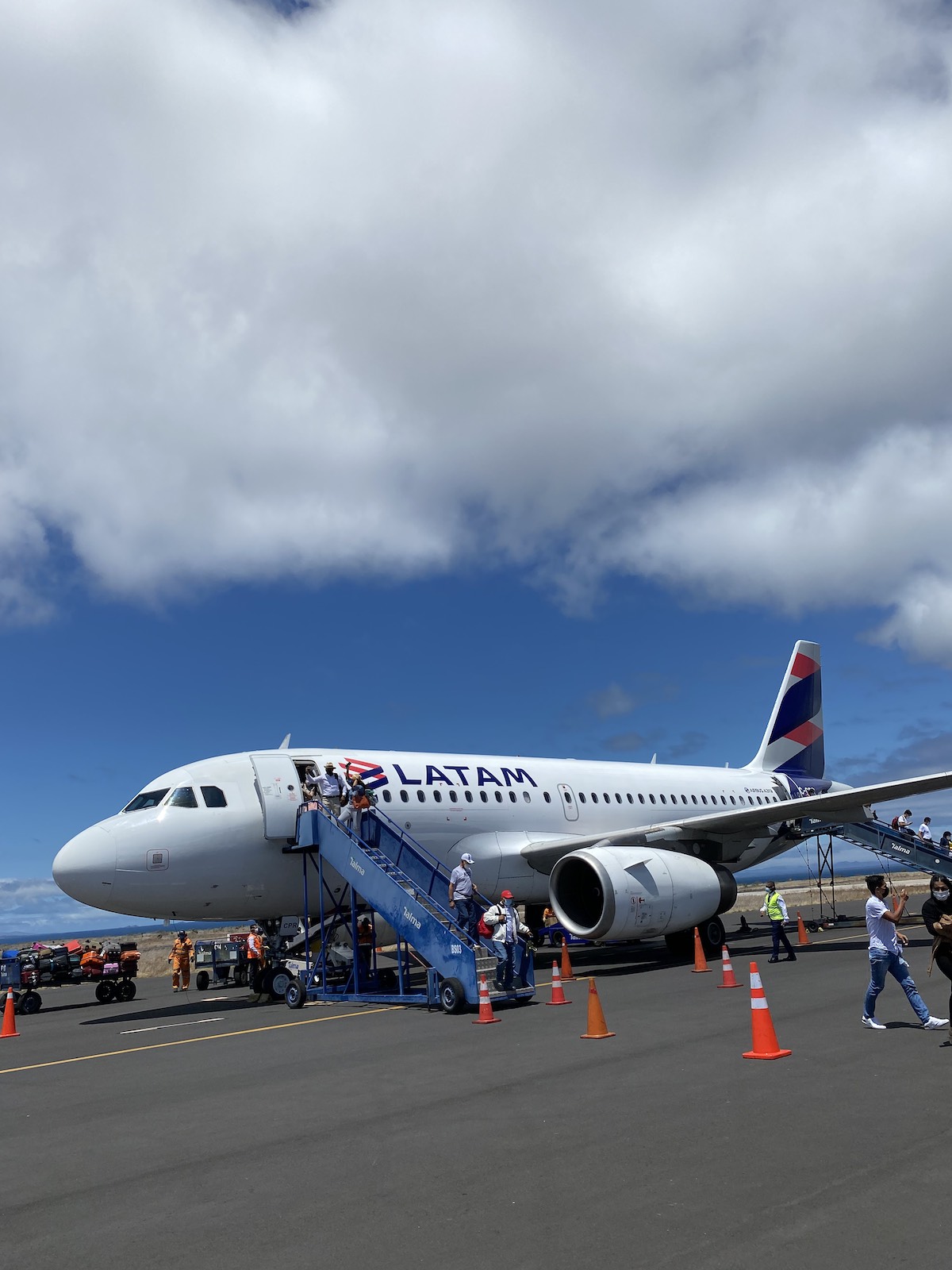
More on this: How To Get To The Galapagos: Flights, Airports And Fees · Galapagos rules
Phones And ESIMs On Arrival
Buy an eSIM before you fly, or get a Claro chip at the Quito airport arrivals hall; both work on the mainland. In the Galapagos, coverage exists only in the towns of the inhabited islands, so expect little to no signal in the highlands or at sea.
| Option | Price | Note |
|---|---|---|
| Airalo eSIM, 1 GB for 3 days | USD 5 | Buy before you fly |
| Airalo eSIM, 3 GB for 3 days | USD 13 | Buy before you fly |
| Airalo eSIM, 5 GB for 7 days | USD 18 | Buy before you fly |
| Airalo eSIM, 10 GB for 7 days | USD 29 | Buy before you fly |
| Claro chip | USD 4, plus a package such as 12 GB for 25 days at USD 8 | Store and kiosks at the Quito airport arrivals hall; passport needed |
| Movistar chip | About USD 5 | Weaker than Claro in the Galapagos |
Prices from esimdb.com (30 September 2026) and claro.com.ec.
A Claro SIM costs USD 4 plus a package, and staff register it against your passport. Movistar also has a presence at the airport. On Santa Cruz and San Cristóbal, Claro coverage is generally slightly broader, while on Isabela both carriers are patchy, often 3G with dropouts. Airalo lists short plans starting at USD 5 for 1 GB.
We used two options on the mainland: Movistar SIMs with unlimited calls and messages plus 15GB of data, and an Airalo eSIM that gave us 3GB for 30 days at USD 21. On our cruise, even WhatsApp struggled to load and checking email was nearly impossible.
More on this: Using US dollars in the Galapagos
FAQ
Do US citizens need a visa for Ecuador?
No visa is needed. According to the US State Department, updated 14 October 2025, US citizens do not need a visa for business or tourism for up to 90 days in any 12-month period. If you want to stay longer, an extension can be requested through provincial migration offices.
How long can you stay in Ecuador as a tourist?
US, UK, Canadian and EU citizens do not need a visa for tourism, and the visa-free stay is up to 90 days in any 12-month period. For UK travelers, you can pay to extend your stay by a further 90 days, and you must apply before the first 90 days end.
Do you need a COVID test or vaccine card for Ecuador?
No. Ecuador dropped its COVID-19 entry requirements on 20 October 2022, and the national mask mandate was lifted on 28 April 2022. No test or vaccination card is needed to enter.
Do you need a yellow fever vaccine for Ecuador?
Not for entry. Since 28 August 2025 Ecuador no longer requires a yellow fever certificate from travelers arriving from Colombia, Peru, Bolivia and Brazil, making vaccination a recommendation instead. The CDC does recommend vaccination for travelers aged 9 months and over going to areas below 2,300 m east of the Andes.
How long must your passport be valid for Ecuador?
At least 6 months. The UK FCDO says your passport must expire at least 6 months after the day you arrive, and the Government of Canada says the passport must be valid for at least 6 months beyond the date you expect to leave Ecuador.
Do you need travel insurance for the Galapagos?
Ecuador's tourism ministry site says foreign tourists must hold private health insurance before entering the Galapagos province. However, the park's arrival-information page does not list it, and rules for the Galapagos are set by CGREG, so check the current CGREG requirements before you buy.
Does your phone work in the Galapagos?
Yes, in the towns. Mobile data and international eSIMs work in the towns of the inhabited islands. Claro generally has slightly broader coverage on Santa Cruz and San Cristóbal, while on Isabela both Claro and Movistar are patchy, often 3G with dropouts. Coverage is limited or absent outside the towns, in the highlands and at sea.